
For the creation of the item list, you can either create a simple item list or you can create a structured one. The structured item list is also taken into account for purchase orders and contracts in SAP. This allows you to create your structured item list with the hierarchy numbers automatically generated from SAP and all other information, including the quotation prices of your suppliers.
In this article is explained how to create a simple item list. You can learn how to create a structured item list with 'Item hierarchies' on the following help page:
Creating a structured item list with Item Hierarchies
Creating an item list
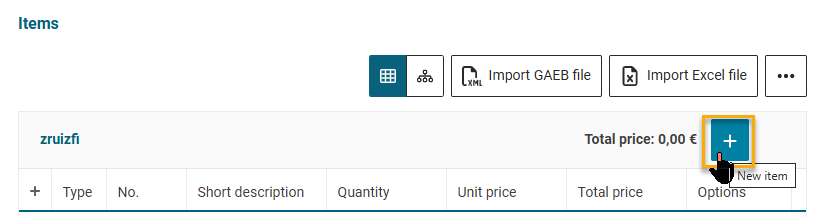
Create free text items for your request by clicking on the button "New item" on the upper right side of the item list. The details window for creating the free text item will then open.
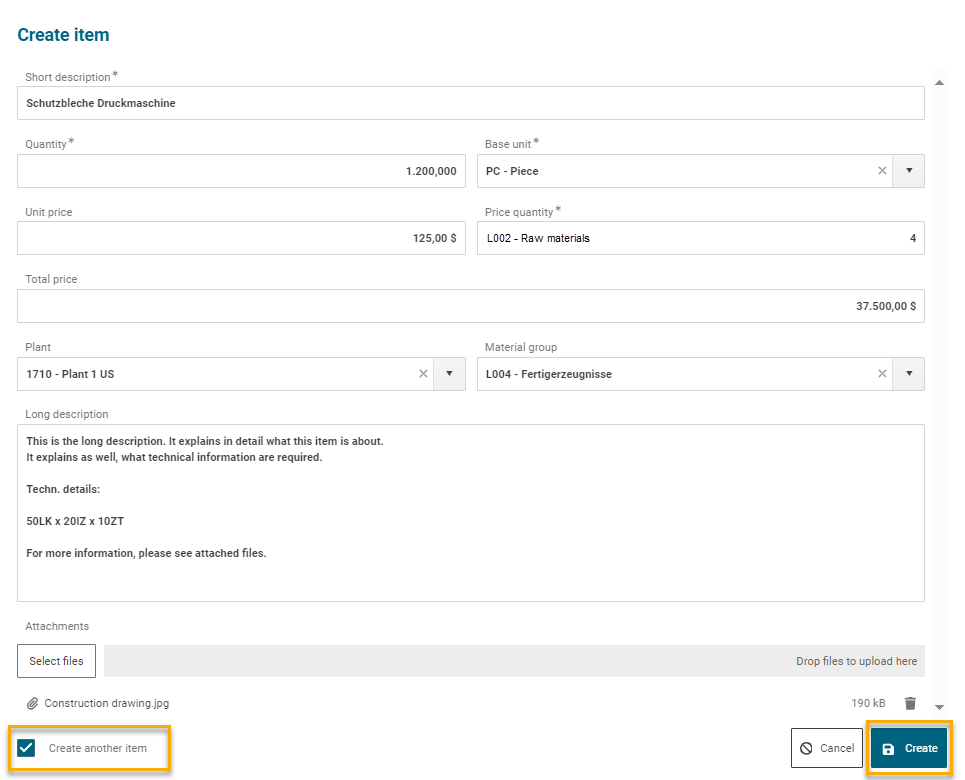
Here you can enter all information about the free text item:
-
Enter the short description, the quantity, the base unit and the price quantity (mandatory fields)
-
If necessary, you can enter a long description. Type in the text in the "Long text" editor field.
-
Add attachments to your item that are specifically related to it.
The unit price and the resulting total price (quantity × price) serve solely as a calculation basis for your evaluation in the price comparison. These prices are not visible to suppliers during the offer preparation.
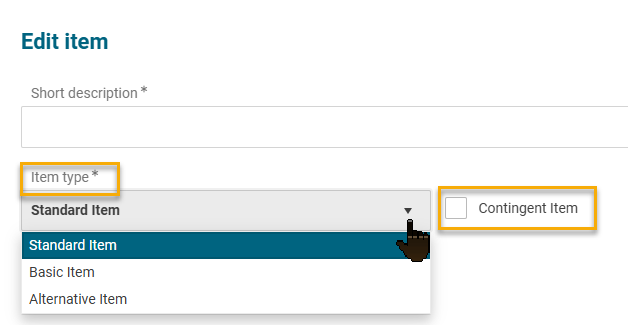
When creating a new item, the item type Standard Item is always set as a preselection. If necessary, change the item type if it is not a standard item.
The available item types are explained later in this article under "Explanation of the item types and their definitions in detail".
Select the option "Create another item" in the lower area of the dialog window, if you plan to create further free text items. After saving (button “Create”), a new dialog window automatically opens for creating another free text item.
If you have finished creating free text items, click on the button "Create". This will take you back to the overview of the item list and you will see your completed free text items.
Creating Note Items
A Note Item is used exclusively for information or explanation within the item list. This allows you to place additional information exactly where it is most relevant to the supplier.
Note items can be created at three different hierarchies within the item list:
-
At the top of the item list
-
At title level
-
Within items level
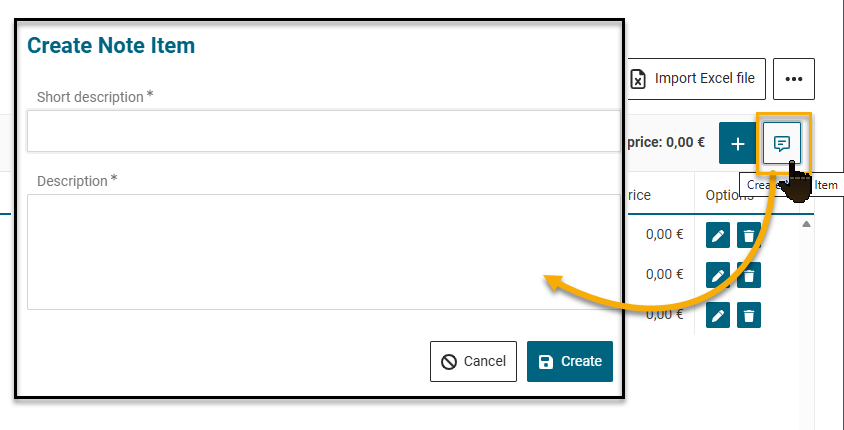
You can use the speech bubble button to create a note item. Two input fields are available here:
-
Short description:
A short, concise name of the note, which is displayed in the overview. -
Description:
The detailed description text (long text) in which the actual information or explanation is stored.
Explanation of the item types and their definitions in detail
In an item list, various item types can be used to provide a clear and structured layout.
Each item type serves a specific purpose and determines how the respective item is handled, displayed, and calculated within the list.
The available item types are explained below:
Standard Item – The default selection for an item. It is included in the item list with its quantity and price as part of the normal calculation.
Basic Item – A main item that serves as a reference or basis. One or more alternative items can be linked to it. In the list, it is marked with a specific symbol.
Alternative Item – An item created as an alternative to a base item. It is always linked to its corresponding base item and automatically assigned a price of 0.00. It is also marked with a symbol in the list.
Contingent Item – A potential but not firmly calculated item. It is also listed with a value of 0.00 and is not included in the total calculation.
Note Item – An item used solely for informational or explanatory purposes. It contains no quantity or price and is therefore not included in the total calculation. Note items can be used, for example, to provide additional technical information, execution conditions, or other explanatory texts within the item list.
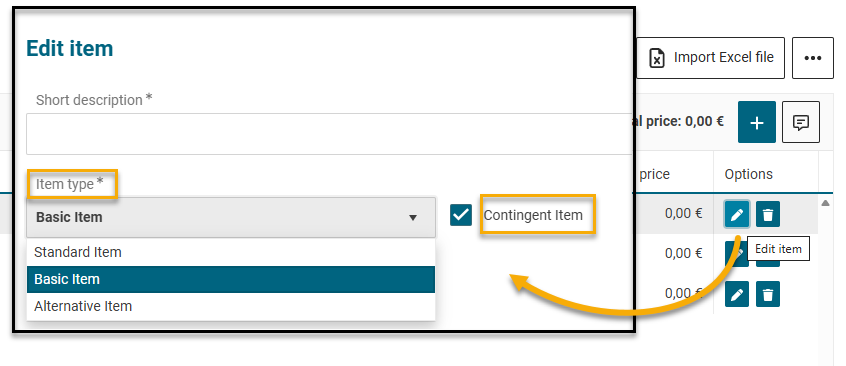
If an item is not a standard item, you can change the item type accordingly.
When importing GAEB files, these item types are automatically recognized and correctly assigned.
This allows you to subsequently convert existing items, such as those imported from a GAEB file into another item type if necessary.
To do this, open the item details using the edit (pencil) button on the right-hand side of the item list.
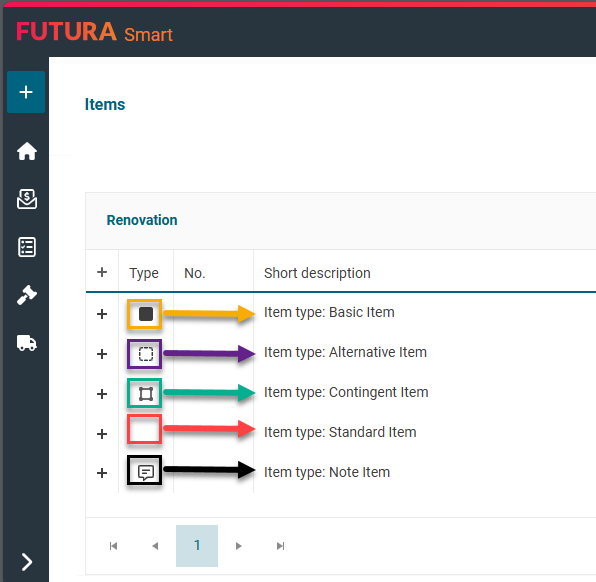
The differentiated item types are displayed with symbols in the overview of the item list:
Download an Excel import template and import of several free text items
To create free text items, you also have the possibility of creating them using an import template. You can do your calculation in it and import the final result into FUTURA Smart.
Notes:
-
Only one file can be imported per process.
-
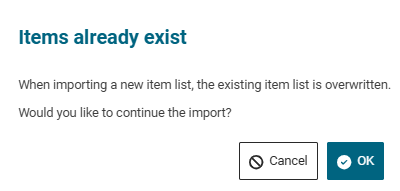
Any new import (whether via Excel or GAEB) replaces an existing item list. This applies to items that were created manually as well as those created through a previous file import. In such cases, a corresponding notification will be displayed.
-
Only GAEB files from version 3.2 onwards are supported.
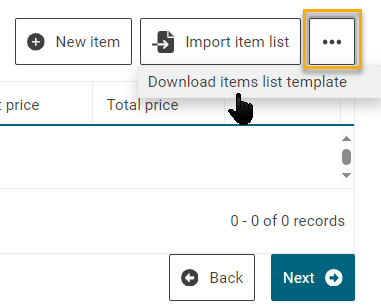
The import template is always available for download on the “Items” tab. You can also download it from here:
FSmart_import template for items.xlsx
The import file contains additional information as a note on the column options, as well as an example of how the item list should be structured. Fill it out with the mandatory criteria...
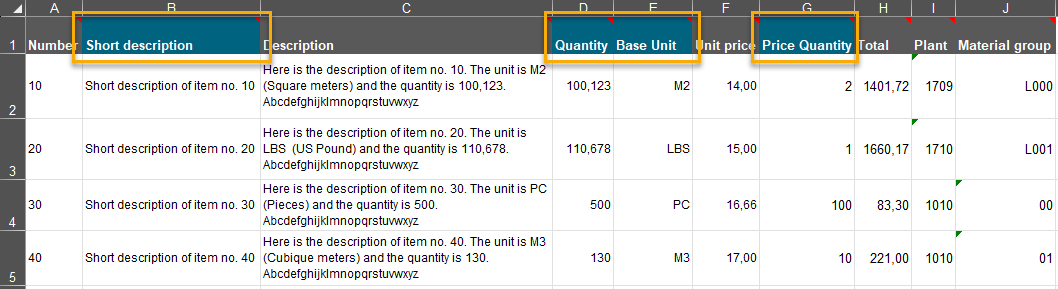
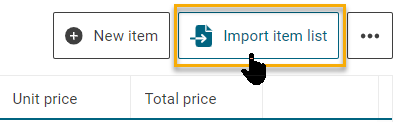
… and then import them into your request using the Import Item List button and function.
After a successful import, the item list will be displayed. Click on the lowest hierarchy level (title folder) on the left-hand side to display the items contained therein on the right-hand side.
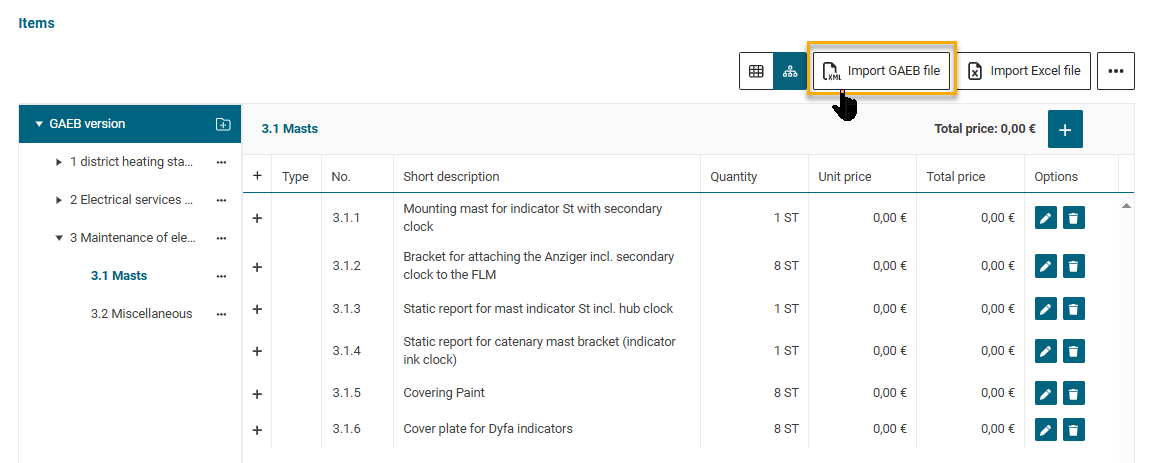
After the import, you can delete or edit individual items from the item list in the right area of the list. To do this, click on the garbage can button or on the pencil button.
Import of an item list via a GAEB file
Item lists in GAEB-XML format from version 3.2 onwards (X81, X82, X83, X86) can also be imported for creating the item list.
During the import, existing lots are adopted as title items (lots = grouping item in GAEB files, used to bundle several items under a single heading), while all other items are imported by default as standard items. The system recognizes the supported item types standard items, base items, alternative items, and optional items and processes them accordingly during the import.
The GAEB file can contain up to four hierarchy levels, which are fully visible in the Items tab after import. If an item list already exists, you may overwrite it by performing a new import.
Notes:
-
Only one file can be imported per process.
-
Any new import (whether via Excel or GAEB) replaces an existing item list. This applies to items that were created manually as well as those created through a previous file import. In such cases, a corresponding notification will be displayed.
-
Only GAEB files from version 3.2 onwards are supported.
How to proceed:
In the Items tab, select the Import GAEB File button.
Then, select the desired GAEB file from your Windows environment and confirm the import.

After a successful import, the item list will be displayed. Click on the lowest hierarchy level (title folder) on the left-hand side to display the items contained therein on the right-hand side.
With the button "Next" at the bottom right, you save your data and switch to the next step "Suppliers".

Click here for step 4: